
— Matt Mullenweg
Governance Structure
WSU’s technology governance structure ensures executive oversight and cross-functional representation requirements. It illustrates the interdisciplinary nature of IT within an institution of WSU’s size and complexity.
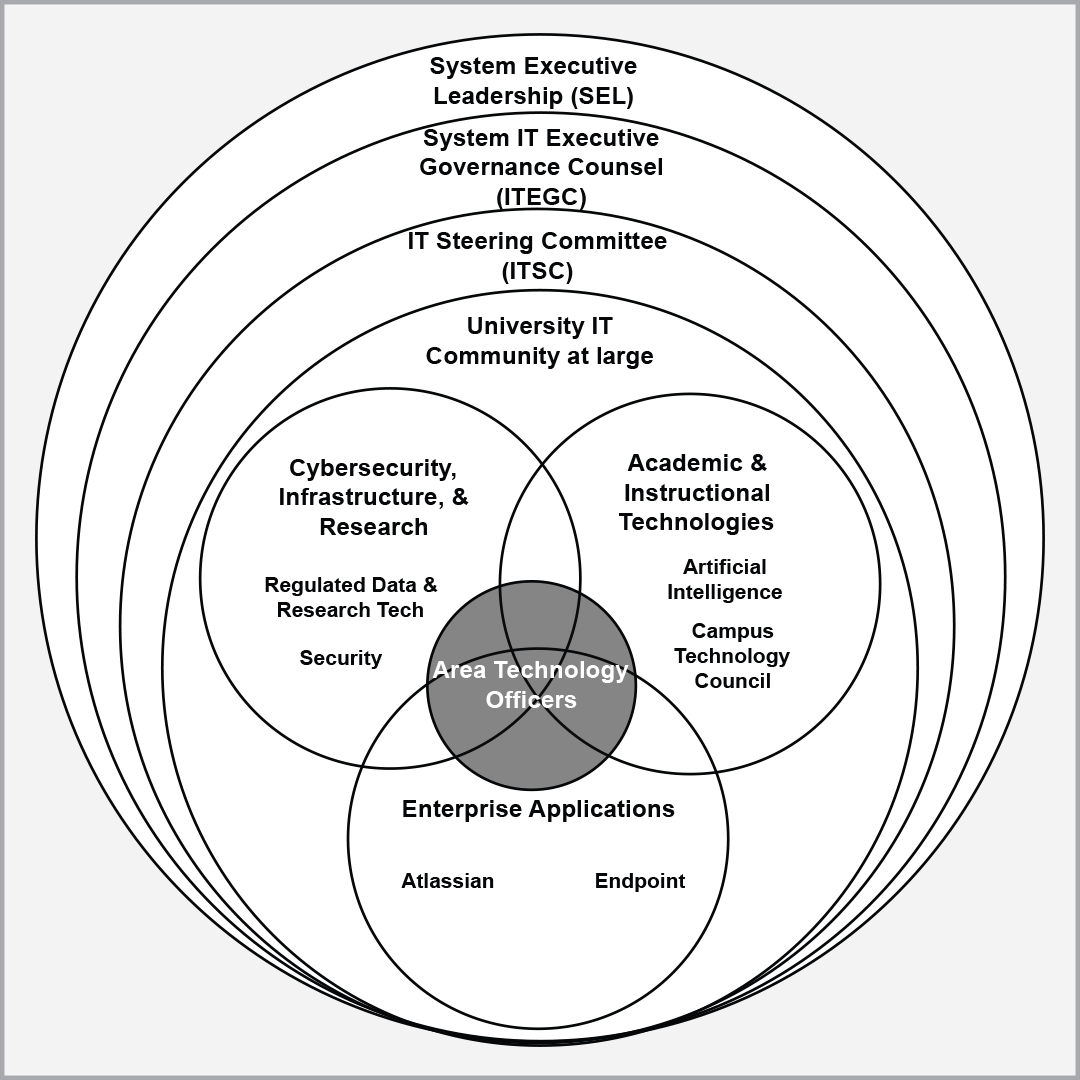
Diagram of University Technology Governance
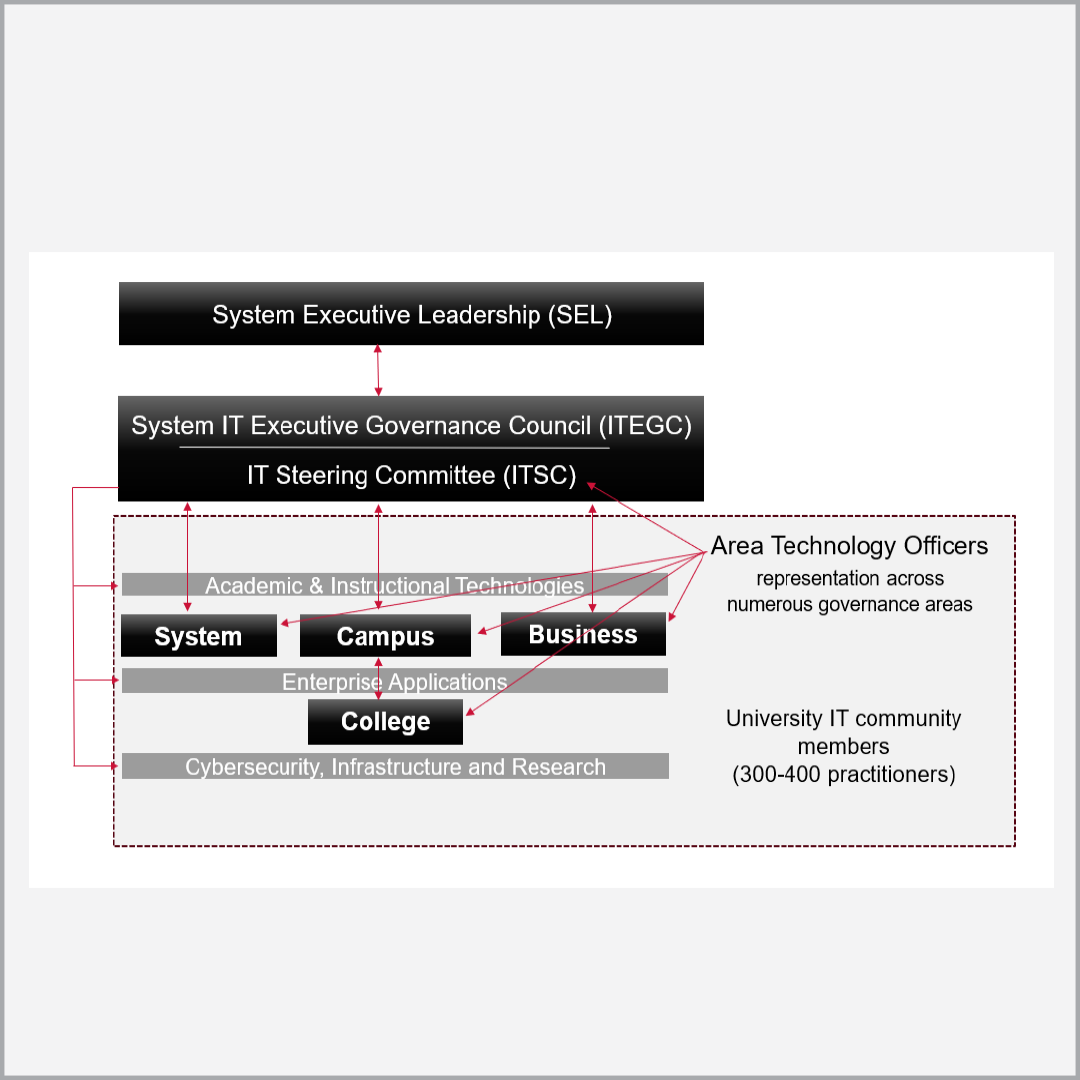
Diagram of university IT governance showing
leadership hierarchy
Expanded membership and functions are provided in the following sections.
Committees Overview
The System Executive Leadership (SEL) oversees the System IT Executive Governance Council and provides strategic guidance, direction, and final approval for IT initiatives.
Membership for the System IT Executive Governance Council (ITEGC) is primarily a mix of executive level individuals that oversee enterprise/campus level IT organizations within their organizational structure as well as the co-chairs of the IT Steering Committee (ITSC) and other individuals appointed by the System Executive Leadership (SEL).
The ITEGC appoints representatives of their interests to the IT Steering Committee (ITSC). It also includes the chairs of all the functional governance committees.
Subcommittees
Focused Working Groups
Focused working groups (FWG) respond to specific institutional technology needs. Each FWG chairperson is also a member of the ITSC.
The Area Technology Officers (ATO) Governance Committee is composed of ATOs appointed by each major area across Washington State University (WSU). The committee provides a university-wide, generalist perspective on technology governance. It serves as an advisory body, offering strategic input and guidance on technology-related initiatives, policies, and decisions that impact the WSU system. The ATO Governance Committee plays a key role in fostering collaboration, ensuring alignment with institutional goals, and promoting effective and efficient use of technology resources across all WSU campuses and units.
Chairs – Wade Lafferty, Sean Girard
The Campus Technology Council (CTC) provides representation from each of the WSU campuses for unique campus technology needs, challenges, and opportunities. Members will foster partnerships and collaboration with the WSU system IT teams and other technology departments for the betterment of all WSU. The Campus Technology Council (CTC) provides recommendations regarding operating practices, processes, and standards within the WSU community.
Chairs – Aaron Brumbaugh, Marshall Fryberger
The Endpoint Management Services Committee is constituted to govern operating practices, processes, and operational standards within the WSU community as applied to computing endpoints. Chair – Matthew Vaughn
The Information Technology Service Management (ITSM) Governance Committee is charged with establishing and maintaining self-governing policies that optimize and protect the integrity, performance, and user experience of the university’s ITSM tools, with a primary focus on Atlassian platforms Jira and Confluence. It advises users, evaluates system effectiveness, and fosters collaboration among stakeholders while aligning ITSM practices with institutional goals.
Chairs – Cat Taylor, Sam Cummings
The Regulated Data Environment & Research Technology Committee is charged with advising on and guiding the development, governance, and continuous improvement of secure, compliant, and researcher-centric technology environments that support the handling of regulated and sensitive research data. The committee ensures institutional alignment with sponsor and regulatory requirements and promotes an infrastructure that enables cutting-edge research at Washington State University.
Chairs – Darren Bystrom, Geoff Allen
The Information Security Governance Subcommittee supports the university’s information security policies, practices, and initiatives. This subcommittee will ensure that WSU’s information security strategy aligns with its overall academic objectives, business objectives, and regulatory requirements.
Chairs – Dave Whelchel, Chuck Harrsch
Service Area Groups
These groups bind the constituent committees above through common technology service areas to form a cohesive system service and governance perspective:
- Academic and Instructional Technologies
- Artificial Intelligence
- Campus Technology Council
- Enterprise Applications
- Atlassian
- Microsoft
- Endpoint
- Cybersecurity, Infrastructure, and Research
- Security
- Regulated Data and Research Technology
Contact
To propose a technology governance request for consideration, or for general questions, please access the WSU Technology Governance request portal. Login is required.